
Premier League Table Chaos
Smaller clubs are performing well, but don’t expect the Big Six to stay quiet for much longer
by Brendan Smith, Sports O'Clock Writing Team Member
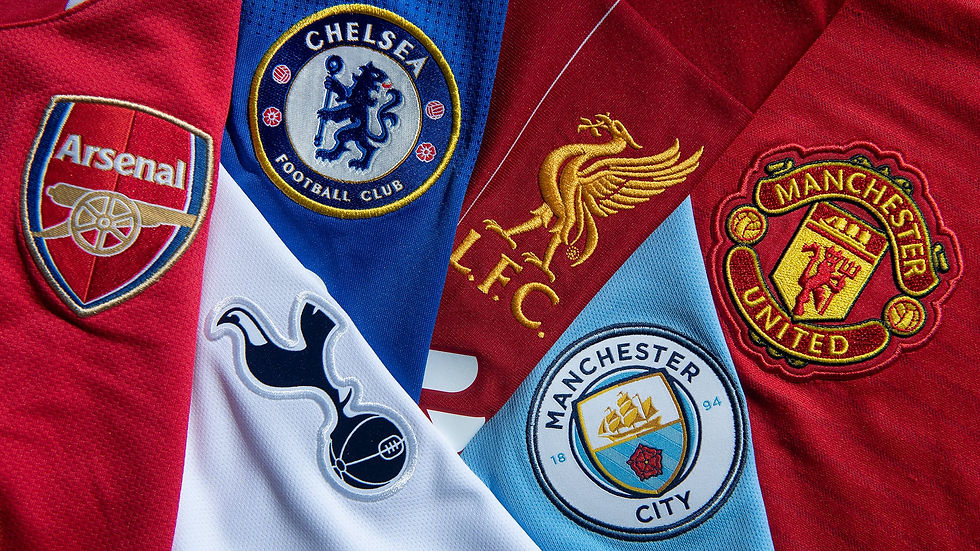
The Big Six clubs: Arsenal, Tottenham Hotspur, Chelsea, Liverpool, Manchester City, and Manchester United (photo credits: Sports Illustrated)
After over a month and a half of the 2020-21 Premier League season, the table is in a state of disorder. Southampton currently sits in the top spot with 16 points, Everton is in 6th, Crystal Palace is in 7th, and Aston Villa is in 9th. Absolutely wild.
Where are the heavy hitters, you ask? Liverpool remain near the top and could move into first place with a win over Manchester City on Sunday. City, meanwhile, are in 11th after six matches played. Chelsea and Spurs are performing as expected and sit in 3rd and 5th, respectively, while Arsenal (10th) and Manchester United (15th) have performed well below expectations.
The slow starts can be attributed to many distinct factors, but none more evident than the lasting effects of the 2019-20 season. United, City, and Arsenal had exhausting European and domestic cup campaigns that ended well after the conclusion of the Premier League season, and it is evident that the wear and tear has not subsided quite yet. Meanwhile, Liverpool, Spurs and the smaller clubs did not have those extra games last season and had plenty of time to refresh before the quick start to this campaign.
Squad depth is also a big factor. Everton, Palace, and Villa retooled and rebuilt their squads, while Chelsea were clearly the most active squad in the transfer window with the signings of Timo Werner and Kai Havertz among others. Both United and City have, in contrast, failed to truly bolster their squads in key areas and are paying the price so far in the season. This could also spell trouble for Liverpool later in the season considering they have a paper-thin squad with very little experienced depth. I expect this issue to be addressed in the January transfer window when these clubs will have a chance to make the necessary additions.
There is still a lot of Premier League soccer left to be played, and history shows that the general hierarchy of clubs has rarely been disrupted during the 28-year history of the league (with the exceptions being Blackburn Rovers in 1995 and Leicester City in 2016). I expect the Big Six clubs to dominate the top half of the table by the end of the season, but in a season that has been impacted by the COVID-19 pandemic, who knows what the table will end up looking like.
(All photos are cited properly. No copyright infringement intended.)

Comments